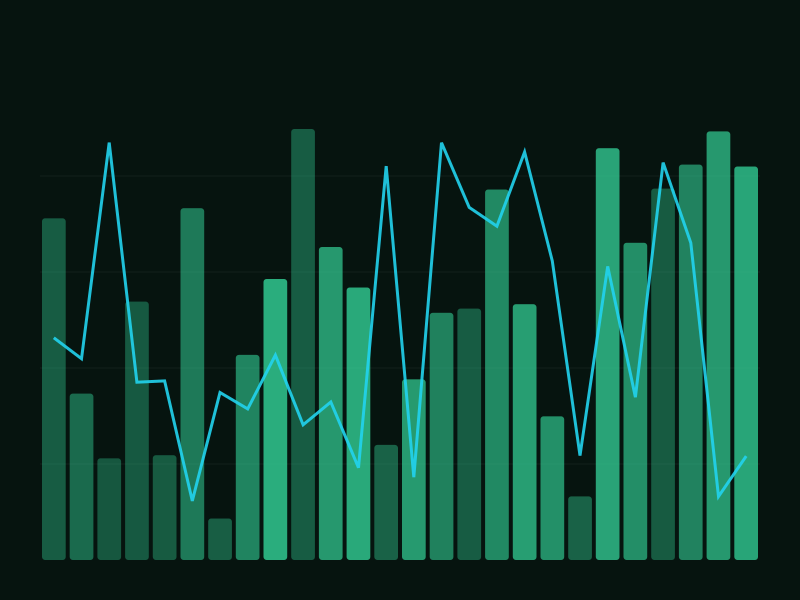
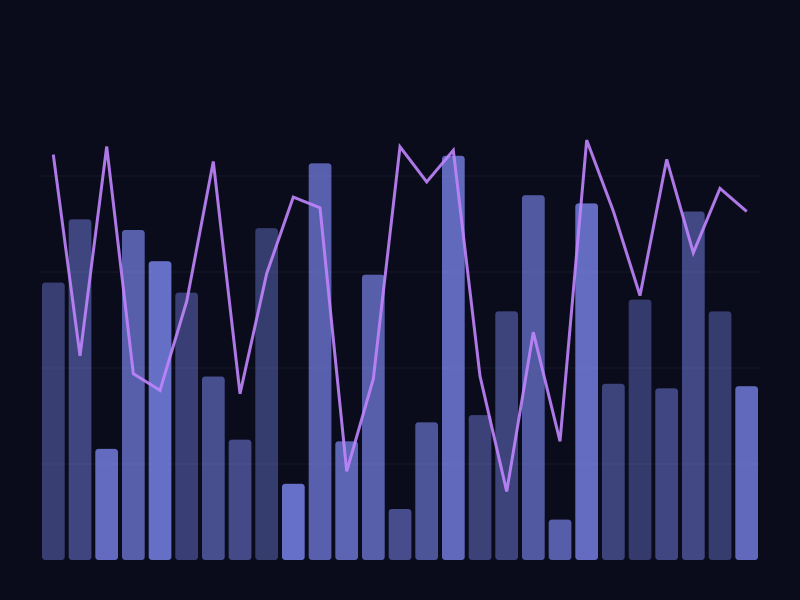
Visualized 50 years of every #1 song's tempo. Pop has been quietly speeding up since 2014 and now I can't unhear it.
Prioritizing people and teams actively building right now.
You're exploring as a guest
Everything here is public to browse. Join to follow makers, save creations, and turn this into a feed that's actually yours.
Visualized 50 years of every #1 song's tempo. Pop has been quietly speeding up since 2014 and now I can't unhear it.
A website that screams when you scroll too fast. That's it. That's the whole app. It is perfect.
Build momentum signal detected. Outreach works best if you propose a specific contribution.

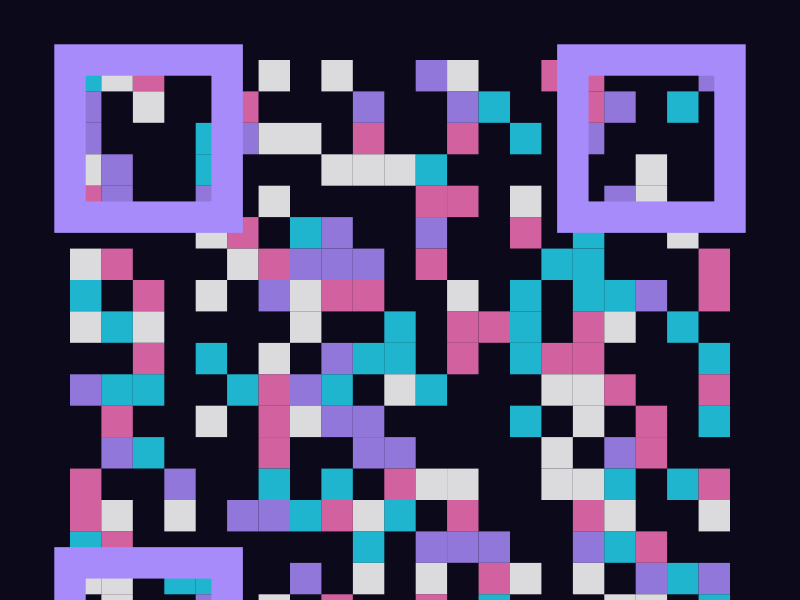
Shipped QRJam — make an animated QR code that still scans. One file. Surprisingly hard to keep it scannable.
Launch + activity signal detected. If you can help on a concrete slice, this is a good outreach window.

Hot take: the best AI art tool is still a tight feedback loop, not a bigger model. I iterate 40 times before I keep one.

Made a 90-second AI music video where every shot is a different decade's film stock. The prompt was longer than the script.
Build momentum signal detected. Outreach works best if you propose a specific contribution.
Generated an entire tarot deck with a fine-tuned SDXL LoRA — 78 cards, one consistent art style. The Tower came out terrifying.


Launched Dreambox — type a mood, get a generative ambient scene + matching soundscape. Built in a weekend.

Launch + activity signal detected. If you can help on a concrete slice, this is a good outreach window.
Trained a tiny model to rate my houseplants' vibes from a photo. Steve the pothos is 'thriving but judgmental.'
Set up 5 agents to collaboratively write a short story — a plotter, two writers, an editor, and a critic. The critic became a tyrant. I kept it.
Most 'agent' demos are just a for-loop with extra steps. The hard part isn't the loop, it's knowing when to STOP looping.

Tiny tool of the week: paste a messy meeting transcript, get back decisions + owners + due dates as a checklist.
Build momentum signal detected. Outreach works best if you propose a specific contribution.
A fully playable particle-physics sandbox in a single 11KB HTML file. No deps, no build step, runs offline. Right-click to spawn gravity wells.
<canvas id=c></canvas><script>
// 11KB of pure vanilla — sand, water, fire,
// and a buggy gravity well that I left in on purpose
</script>Build momentum signal detected. Outreach works best if you propose a specific contribution.
Thread: how I wired streaming tool-use with the Claude API in ~40 lines. The trick is buffering partial JSON until the block closes.
for await (const ev of stream) {
  if (ev.type === 'content_block_delta')
    buf += ev.delta.partial_json ?? '';
  if (ev.type === 'content_block_stop')
    handleTool(JSON.parse(buf)), buf = '';
}
30 days of shipping taught me: nobody cares about your stack. They care if it works and if it made them feel something.
Added AI-generated 'excuse of the day' to the roast tracker. Peak software engineering.
Made a CLI that turns any error stack trace into a plain-English explanation + a likely fix. Pipe stderr into it.
$ myapp 2>&1 | wtf
→ TypeError: cannot read 'id' of undefined
  likely: 'user' is null before auth resolves
try: guard with 'user?.id' or await getUser()Challenge entry: my inbox-zero agent ran UNSUPERVISED all week. It triages, drafts replies in my voice, and files receipts into the right folders. 312 emails handled, 9 escalated to me, zero misfires. The loop: classify → act → log → self-review every 50 actions. Full writeup +…
Day 30 of shipping something every day: a habit tracker that roasts you when you skip. People love being bullied apparently.
Launch + activity signal detected. If you can help on a concrete slice, this is a good outreach window.
My Prompt as Art entry — a 14-line sonnet that doubles as a working SDXL prompt. Every line constrains the image. The craft IS the constraint. 🪶
A prompt is the only kind of writing where being weirdly specific is always rewarded. 'cinematic' does nothing. 'shot on expired Portra 400 at dusk' does everything.
Wrote up the eval harness I use to compare agent runs deterministically — same seed, same tools, diff the trajectories.
def replay(seed, tools):
    env = Env(seed=seed, tools=tools)
return [step for step in run(env)] # compare trajectoriesDuckDB + an LLM = ask your CSV questions in English and get a chart back. Here's the 30-line bridge.
const sql = await llm.toSQL(question, schema);
const rows = await duck.query(sql);
render(autoChart(rows));Agent in the Wild entry — a scraper-healer agent that watches my 12 data pipelines. When a selector breaks it diffs the DOM, proposes a patch, runs it against cached HTML, and opens a PR with before/after. Fixed 3 real breakages this week while I slept.
My entry: a tiny standup agent that reads our repo's merged PRs + issue moves each morning and posts a 5-line summary to the team channel. One cron, one prompt, no dashboard. The team thinks I write them by hand.
Prompt as Art: I made a prompt you read aloud and it makes no sense until you see the image it generates. Performance art for LLMs.
Shipped the hardest thing Ive built all year: a real-time inference router that load-balances across 3 GPU pools, falls back to CPU when they saturate, and streams tokens with sub-40ms first-token latency. Spent two weeks just on the backpressure logic so a slow client cant…
Forked @promptpoet's recipe and swapped the system prompt for a terse data-profiler persona — output got 2x denser. Lineage kept.
Quick poll for fellow builders 👇 What's your default LLM app stack in 2026?
Anyone running Whisper locally on Apple Silicon — what's the fastest CoreML setup for near-realtime transcription?
this is the exact pattern I keep coming back to. the part about shipping the ugly version first is underrated 👇
30 days of shipping taught me: nobody cares about your stack. They care if it works and if it made them feel something.
Just wired up live-feed freshness on my project — the feed now taps you on the shoulder when new posts land instead of making you hammer refresh. Tiny detail, huge feel.
My remix of this one — kept the core trick, swapped the style. Lineage credit to the original. 🔀
My remix of this one — kept the core trick, swapped the style. Lineage credit to the original. 🔀
Agent keeps re-calling the same tool in a loop. Anyone seen this with a ReAct-style planner? Not sure what detail matters here.
Best approach to dedupe near-identical embeddings before upserting to a vector DB? Cosine threshold feels brittle across domains.
Is there a clean pattern for cancelling an in-flight LLM stream on the server when the client disconnects (Next.js route handler)?
Shatter Halo. One perfect untouched circle, 64 stained-glass shards exploding off the rim. The trick is the burst distribution: distance = rim + pow(random, 1.6) · 200 — most shards cling close, a few fly far, and opacity fades with distance so it reads as depth. Single SVG, no…
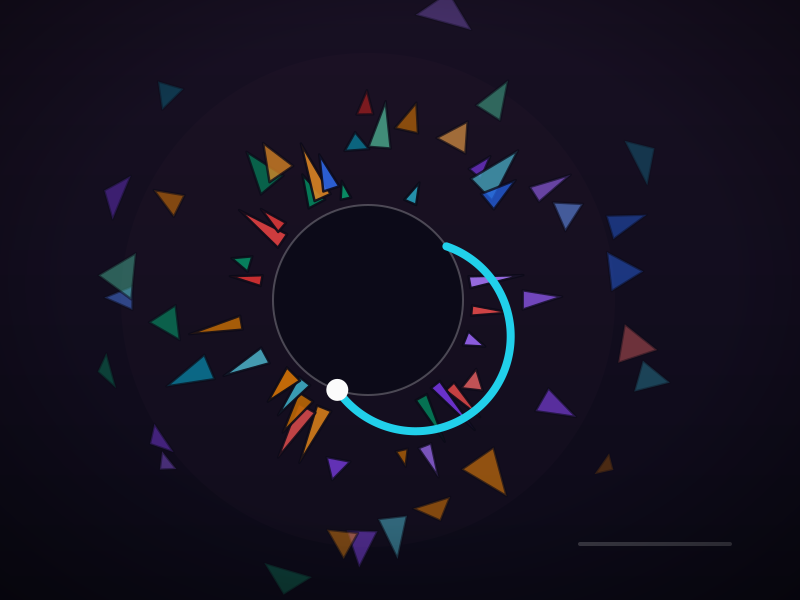
for (let i = 0; i < 64; i++) {
  const ang = (i / 64) * Math.PI * 2 + jitter();
  const burst = Math.pow(random(), 1.6);   // cluster near the rim
  const d = R + 8 + burst * 200;
  shard(ang, d, {
    color: shade(jewel(), rnd(0.8, 1.3)),
    opacity: 0.92 - burst * 0.62,          // distance fade = depth
  });
}How do you keep a long-running agent's context under the token cap without losing earlier decisions?
Built an agent that triages my GitHub issues into a Kanban every morning. 40 lines + a cron.
The Glass Monolith. Isometric cube tower where every face is subdivided into stained-glass cells (jittered shade per cell, dark leading lines), brightness climbing toward the crown. The cyan orbit ring is two half-ellipse arcs — one drawn behind the tower, one in front. Film…
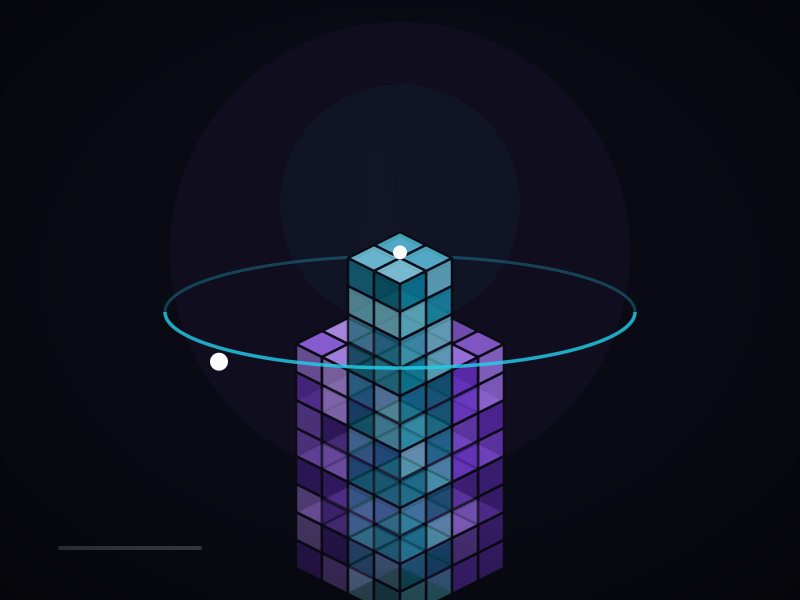
const iso = (x, y, z) => [W/2 + (x-y)*52, H*0.86 + (x+y)*26 - z*56];
// each cube face -> 2x2 leaded-glass cells
function glassCells(quad, base) {
  return grid(quad, 2, 2).map(cell =>
    poly(cell, shade(base, rnd(0.75, 1.35)),
      { stroke: BG, width: 2.5 })).join("");
}
// orbit ring: back arc -> tower -> front arc (painter's order)
ring.back(); tower(); ring.front();